The day you move abroad, your Indian bank accounts change category. Choosing the right NRI account decides how much tax you pay in India and how easily you can move money back out. Here's the plain-English version.
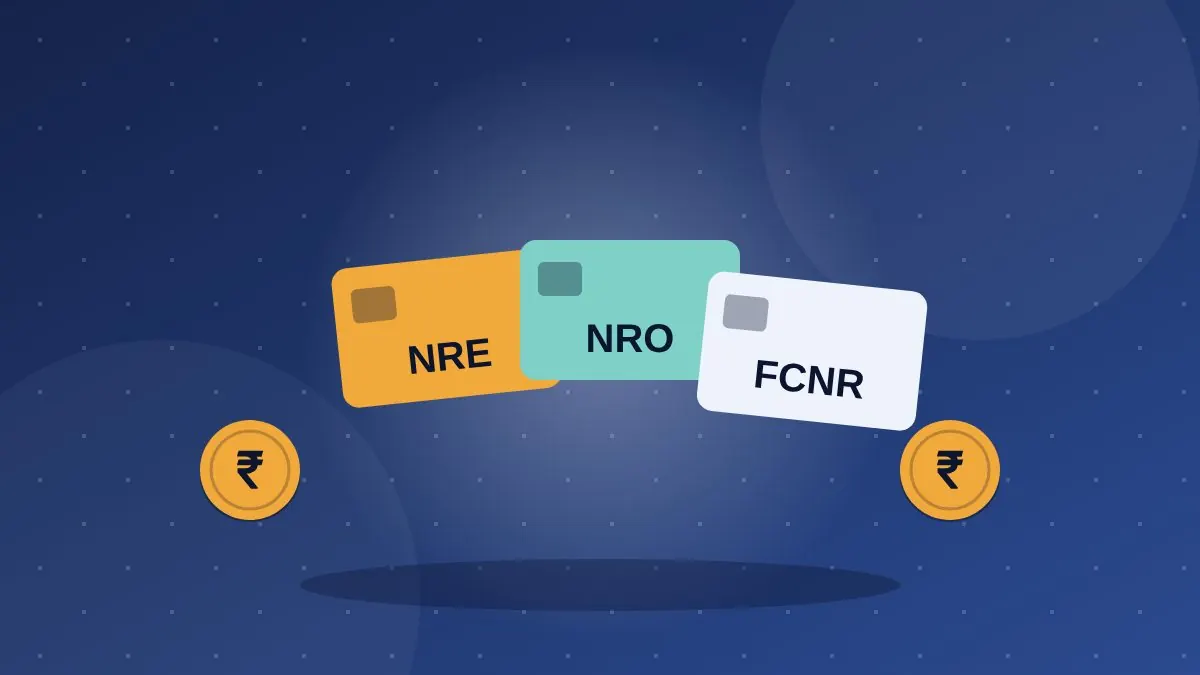
The three accounts at a glance
| NRE | NRO | FCNR (B) | |
|---|---|---|---|
| What goes in | Money earned abroad | Income earned in India (rent, dividends, pension, sale proceeds) | Money earned abroad, kept in foreign currency |
| Currency | Indian rupees | Indian rupees | USD, GBP, EUR and other major currencies |
| Interest taxed in India? | No — tax-free | Yes — TDS of 30% plus surcharge and cess | No — tax-free |
| Repatriation | Fully repatriable | Up to USD 1 million per financial year | Fully repatriable |
| Account types | Savings and FD | Savings and FD | Fixed deposit only (1–5 years) |
| Exchange-rate risk | Yes | Yes | No |
NRE: for money you earn abroad
Send your foreign salary or savings into an NRE account. The interest is tax-free in India, and you can move the full balance — principal and interest — back abroad whenever you like. The money is held in rupees, so if the rupee weakens, your balance is worth less in dollars or pounds.
Remember that "tax-free in India" doesn't mean tax-free everywhere. US, UK and Canadian residents, for example, generally have to report this interest in their home tax return.
NRO: for income that arises in India
Rent from a flat in Pune, dividends from Indian shares, your pension, or the proceeds of selling property all belong in an NRO account. Your old resident savings account must also be converted to NRO once you become an NRI.
- Interest is taxable, and banks deduct TDS at 30% plus surcharge and cess. If your actual tax is lower, you can claim the excess back by filing an Indian tax return, or apply treaty (DTAA) rates — see our DTAA guide.
- You can send up to USD 1 million per financial year abroad from NRO balances, after taxes are paid. Read how NRO repatriation works.
FCNR: for avoiding currency risk
An FCNR (B) deposit holds your money in foreign currency — say, US dollars — inside an Indian bank. Interest is tax-free in India and the deposit is fully repatriable. Because there's no conversion to rupees, you're protected if the rupee falls. The trade-off: FCNR rates usually track foreign interest rates, so they're often lower than NRE rupee FD rates.
Which one should you use?
- Most NRIs need both NRE and NRO. NRE for money you bring in; NRO for money you earn in India.
- Planning to return abroad with the money? Keep it in NRE or FCNR so it stays freely repatriable.
- Worried about the rupee? Consider FCNR for part of your savings.
- Never mix them up. Indian income must not be deposited into an NRE account — that's a FEMA violation.
Frequently asked questions
Is NRE account interest taxable in India?
No. Interest on NRE accounts is tax-free in India while you are a non-resident. It may still be taxable in your country of residence.
How much can I send abroad from an NRO account?
Up to USD 1 million per financial year (April–March), after taxes are paid and the required tax forms are filed.
Can I keep a regular savings account after becoming an NRI?
No. Under FEMA, resident savings accounts must be re-designated as NRO accounts once you become a non-resident.
Get stories like this every morning
Top stories, scam alerts and rule changes — free, every morning at 7 am IST.
For general information only — not financial, tax or legal advice. Rules and rates change; verify with official sources or a qualified professional. Read our disclaimer.